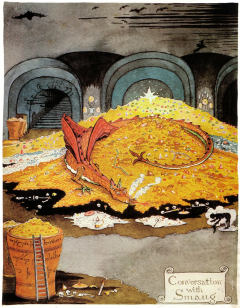
Today, as I understand it, is the 40th anniversary of Dungeons & Dragons, and thus in a way the entire RPG hobby. What better day, then to continue my series examining ten of the games that have been closely inspired by it?
Possibly the most important part of the rules, it's no surprise that all of the retro-clones I'm reading through have the character creation rules right up front. For the next few read-through posts, I'll be creating a character for each game, following the processes of each as closely as possible.
While many of them suggest various ways to generate it, all of them use the general "Six stats in the 3-18 range" mechanic. In order to test the rules as scientifically as possible, I'll be rolling one set of stats the traditional way - 3d6 In Order, of course - and applying them to each. So, without further ado, here are the numbers:
10, 15, 9, 9, 13, 9, 9
Not a bad spread, altogether, though the number of nines seems a bit of an anomaly - and yes, there's an extra at the end, I got a bit carried away with the dice-rolling and decided to keep it around in case any of the rulesets have an oddball stat or something. Anyway, let's take a look at what we can do with these numbers:
Sunday, January 26, 2014
Retro-clone Read-through - Character Creation, Part I
Wednesday, January 22, 2014
A Trio of Hypothetical FAE Campaigns
Although I'm a big fan of the Fate system, one thing about it I've never been able to properly visualized is how the advancement/character improvement mechanics are supposed to work. It is, of course, perfectly valid to play without having this feature, but I suspect there are a great many who are used to it.
Today, however, I came across not one, not two, but three different examples of how the process could work, using fictional characters as an example. Interestingly, all three use the Accelerated version of Fate, though the examples are applicable across all Fate variants.
First off, we have Luke Skywalker. Posted by Sketchpad, this example breaks each Star Wars movie into three parts, giving examples of various Milestones and even a Major Consequence (that hand-chopping thing). Also of interest to me was the last Stunt taken by Luke - "+2 when I forcefully defend myself from relatives" is, in terms of movie plot, useful exactly twice, one of which inspired Luke to take it. Presumably when the campaign continues this will get changed, but it's an interesting example of how fluid Stunts can be, as when as you read the rules they seem much more permanent.
The other two examples come from a newfound blog called Station53: the first is Batman, by Mike Lindsey, which uses Batman: Year One to show how Milestones can be used to tweak character concepts; and Conan by Reagan Taplin. This one is, in my opinion, the most impressive, as it uses all the Conan stories to build an ongoing picture of the Cimmerian's journey from thief to king. It's also kind of amusing to see the "Sneaky" and "Careful" approaches switching back and forth as one or the other become more important.
All three of these are well worth reading, as they make the prospect of a longer-term Fate campaign a much more graspable concept.
![]() |
| Sean-izaakse shows us the outcome when the latter two characters meet. |
Friday, January 3, 2014
The Great 2014 Retroclone Readthrough
Over the past few years, a great many different versions of Dungeons & Dragons have been produced, several officially, but the vast majority being retroclones or house rule collections of one sort or another. The author of one of them (Grey Six) has assembled a vast and possibly even comprehensive list of variations, the scope of which underscores the creativity of the OSR community.
It also underscores the difficulty of keeping up with them all. For some time, I've had a bunch of different rulesets sitting around waiting to be read, and so I figured - hey, it's a new year, why not read the whole stack at once and do a comparison?
Tuesday, December 17, 2013
The Oldest School
Via Doc Grognard at Crawdads and Dragons comes news of Balrogs and Bagginses, an intriguing little document that is billed by Lars Dangly, the author, as a rules supplement for playing Dungeons & Dragons in J. R. R. Tolkien's Middle-Earth setting.
Truth be told, it's practically a retroclone unto itself, with a number of interesting variations on the usual theme. Classes, for example, do not appear as such but are custom-built out of Backgrounds and Abilities. One particularly noteworthy feature here is the Hit Die, which can be bought up from d6 to d12, or bought down to d4.
Another fascinating design choice surrounds the available races - while the main character creation rules support the standard human-elf-dwarf-hobbit choices, the bestiary listings for troll and the various sorts of orcs list the attribute modifiers for playing those races, making an orc-campaign (or even a mixed group!) a supported possibility while keeping the Tolkienian feel.
The rest of the work supports this feel as well - Turning Undead, to pick a rather random example, is based not on the non-existent Cleric class, but the Light of Valinor or Elvish Gift abilities. There's a few other pieces that don't fit quite as neatly - such as the hilariously hardcore Madness rule - but it's definitely worth checking out if you have any interest in Middle-Earth as a setting.
Monday, December 9, 2013
"You All Meet in a Tavern"
From the vast frozen plains of Canada and the band Scythia comes this highly entertaining look at one of the standard fantasy adventuring tropes.
Random Encounters At the Bear Claw Tavern
Roll d6:
1) Two rough-looking patrons arm-wrestle. The winner will accept any challenges for a 5CP bet.
2) A distinguished-looking wizard serenely reads from a small tome. He will ignore most attempts at interaction, but persistent annoyance may result in a retaliatory zap (lose 1 HP).
3) A love triangle fluctuates among a male patron, a female patron, and a barmaid - at any point, one might start flirting with a PC to make the other two jealous.
4) The tavern's owner displays its namesake, a seemingly authentic bear claw far bigger than it should be.
5) A flabby gnome wanders around trying to steal food and drink from the other patrons. If encouraged, he can consume a surprising amount of drink.
6) Minstrels sing of heroes and legends.
Monday, October 28, 2013
Monstrous Mushroom Kingdom Monday - The Finale
![]() |
| Art by JoshSummana |
Bowser, the King Koopa: A massively over-sized Koopa warrior, Bowser claims kingship over the Mushroom Kingdom, and controls a vast army of Koopas, Goombas, and other creatures to make the claim stick. He's also not above kidnapping the family of the previous rulers to magnify his claim.
![]() |
| Art by Davidleonluis |
Alignment: Evil
Size: Large
Movement: 30
Dexterity: 7
Armor Class: 3 (16)
Hit Dice: 8
Attacks: 3 (bite/claw/jump)
Damage: 2d8/1d6/1d20
Saving Throw: 13
Morale: 7
Experience Points: 1000
Treasure Class: Y
Special: Once per turn, Bowser can breathe a Fireball as an 8th-level magician.
Monday, October 21, 2013
Monstrous Mushroom Kingdom Monday - Part The Third
In addition to the standard flora and fauna of the Mushroom Kingdom, there are a great many artificial creatures that pose a threat to any wandering adventurers. Oftentimes their origin is unknown, and any intelligence they might have possessed has long been worn away by time.
Chain Chomp: A dense, metal ball with a toothy mouth at the end of a chain, which is typically secured to a wall or post. Often used as guardians, and therefore found just outside structures of strategic or financial importance.
Encountered: 1-2
Alignment: Chaotic
Size: Small
Movement: 0 (See Special)
Dexterity: 10
Armor Class: 3 (16)
Hit Dice: 3
Attacks: 1 (bite)
Damage: 1d8
Saving Throw: 15
Morale: 13
Experience Points: 35
Treasure Class: M
Special: After three rounds, roll a d6 each round. On a 1, the chain breaks and the Chain Chomp gains MV 60.
Bob-omb: A metallic ball on mechanical legs, which it uses to walk up to its target before exploding. The turn before the explosion, it throws several harmless sparks from its top.
Encountered: 1 (1d4)
Alignment: Neutral
Size: Small
Movement: 40
Dexterity: 8
Armor Class: 3 (16)
Hit Dice: 2
Attacks: 1 (explode)
Damage: 3d6
Saving Throw: 16
Morale: 10
Experience Points: 24
Treasure Class: M
Special: If the Bob-omb is reduced to 0HP before setting itself off, it explodes for 2d6 damage to whatever struck the killing blow.
Thwomp: An enormous, spiky block of living stone that camouflages itself against stone ceilings, then drops on the unwary.
Encountered: 1 (1d4)
Alignment: Chaotic
Size: Large
Movement: 10
Dexterity: 9
Armor Class: 5 (14)
Hit Dice: 4
Attacks: 1 (smash)
Damage: 1d12
Saving Throw: 15
Morale: 11
Experience Points: 75
Treasure Class: M
Chain Chomp: A dense, metal ball with a toothy mouth at the end of a chain, which is typically secured to a wall or post. Often used as guardians, and therefore found just outside structures of strategic or financial importance.
![]() |
| Art by darkly-shaded-shadow |
Alignment: Chaotic
Size: Small
Movement: 0 (See Special)
Dexterity: 10
Armor Class: 3 (16)
Hit Dice: 3
Attacks: 1 (bite)
Damage: 1d8
Saving Throw: 15
Morale: 13
Experience Points: 35
Treasure Class: M
Special: After three rounds, roll a d6 each round. On a 1, the chain breaks and the Chain Chomp gains MV 60.
Bob-omb: A metallic ball on mechanical legs, which it uses to walk up to its target before exploding. The turn before the explosion, it throws several harmless sparks from its top.
![]() |
| Art by Deimos-Remus |
Alignment: Neutral
Size: Small
Movement: 40
Dexterity: 8
Armor Class: 3 (16)
Hit Dice: 2
Attacks: 1 (explode)
Damage: 3d6
Saving Throw: 16
Morale: 10
Experience Points: 24
Treasure Class: M
Special: If the Bob-omb is reduced to 0HP before setting itself off, it explodes for 2d6 damage to whatever struck the killing blow.
Thwomp: An enormous, spiky block of living stone that camouflages itself against stone ceilings, then drops on the unwary.
![]() |
| Art by BrendanCorris |
Alignment: Chaotic
Size: Large
Movement: 10
Dexterity: 9
Armor Class: 5 (14)
Hit Dice: 4
Attacks: 1 (smash)
Damage: 1d12
Saving Throw: 15
Morale: 11
Experience Points: 75
Treasure Class: M
Subscribe to:
Posts (Atom)